
Traffic Engineer Insights for Smoother Project Approvals
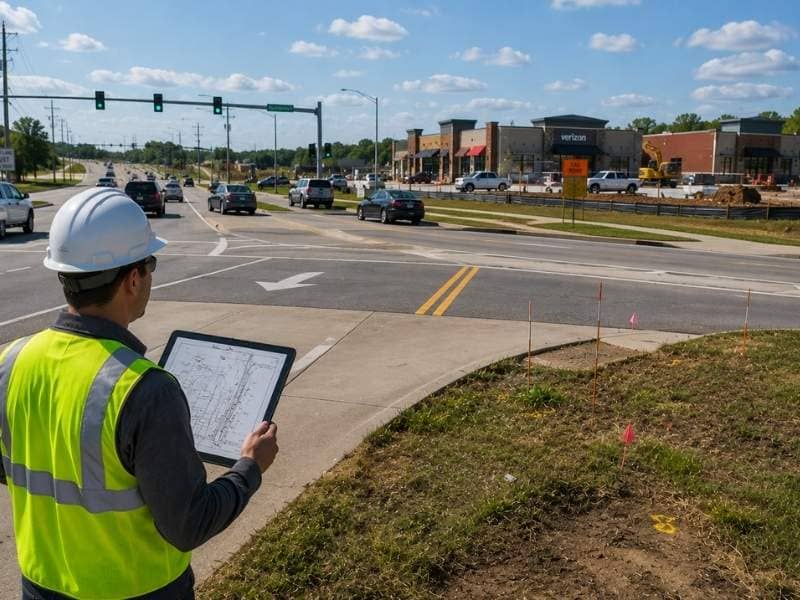
A traffic engineer helps project teams identify transportation issues before they become approval delays. From driveway access to traffic studies and agency coordination, a traffic engineer provides the technical information reviewers need to evaluate how a proposed development will affect nearby roads. Most developers focus on the building. Reviewers focus on the road. That gap explains why so many projects stall on questions nobody prepared for.
Approval delays rarely come from a bad design. They come from a late one. Bring a traffic engineer in early, and most of the friction disappears before it starts.
A Traffic Engineer Should Confirm Transportation Review Requirements Early
Every jurisdiction sets its own rules for what a project owes the road network. Some require a full traffic impact study. Some want a shorter access analysis. Some ask for nothing at all until the trip counts cross a threshold.
Guessing wrong costs months. A team that submits without a required study gets bounced. A team that pays for a full study they never needed burns the budget for nothing.
A traffic engineer answers that question in the first week. They check the local thresholds, confirm which agency holds authority over the road, and identify whether a state or county office also gets a say. Roads owned by different agencies follow different rules, and a single driveway can trigger two separate reviews.
Knowing the scope upfront lets the whole schedule form around it. Studies take time. Counts need collecting. A project that learns its requirements at month four has already lost the months it needed.
Traffic Engineer Coordination for Driveway and Site Access Planning
Access is where most projects meet resistance. A driveway looks simple on paper. Reviewers see something else: a new conflict point on a road they already manage.
The traffic engineer works through the details that decide whether an access point survives review:
- Sight distance in both directions from the proposed driveway
- Spacing from the nearest intersection and from neighboring driveways
- Turn lane needs for vehicles entering and leaving the site
- Whether the entrance handles trucks, and how those trucks turn
- Internal circulation, so cars don’t stack out onto the public road
- Whether the site needs one access point or two
Reviewers push back hardest on sight distance and spacing. A driveway placed near a curve or crest, or dropped too close to an intersection, gets rejected regardless of how well the rest of the site works. Catching that early means moving a line on a drawing. Catching it late means redesigning half the site.
Traffic Engineer Responses That Keep Agency Reviews Moving
Comments will come back. That part is normal, and it isn’t a sign anything went wrong.
What matters is the response. A vague reply invites another round of comments, and each round adds weeks. A clear reply that answers the exact question, points to the exact sheet, and explains the change ends the conversation.
Good responses share a few habits. They address every comment individually rather than lumping them together. They show the analysis behind a conclusion instead of asserting it. When the engineer disagrees with a comment, they say so directly and explain the technical basis, because reviewers respect a defended position more than a silent one.
Speed helps too. A response that goes back in ten days keeps the file on the reviewer’s desk. A response that takes ten weeks pushes the project to the bottom of a queue that has since filled with other work.
Traffic Engineer Coordination With the Overall Site Plan
Traffic work fails when it happens in isolation. The engineer needs to sit alongside the civil designer, the architect, and the surveyor, because access decisions ripple through everything else.
Move a driveway and the parking layout shifts. Add a turn lane and the property may need more right of way, which changes the buildable area. Widen an entrance for truck turns and the landscape buffer shrinks, which can trip a zoning requirement.
Each of those consequences is manageable when the team catches it during design. Each one is painful when it surfaces after the site plan is drawn and the pro forma is set.
Shared drawings solve most of this. When everyone works from the same base survey and the same current layout, the traffic engineer’s recommendations land in a plan that can actually absorb them.
Frequently Asked Questions
When should a traffic engineer join a project team?
Before the site plan takes shape. The access point, the internal circulation, and any required road improvements all influence how much of the site remains buildable. A team that designs the building first and studies traffic second often ends up redesigning both.
What triggers a traffic impact study?
Local rules decide it, and the thresholds vary. Most jurisdictions tie the requirement to the number of trips a project generates, the type of use, the size of the development, or the classification of the road it connects to. Some also require a study whenever a project adds a new access point to a major road, regardless of size.
Can a project get approved without any road improvements?
Often, yes. Smaller projects on roads with available capacity frequently clear review with no improvements at all. Requirements appear when a project adds enough traffic to strain an intersection, when sight distance falls short, or when the road classification calls for a turn lane at the new entrance.
