
Construction Management Strategies for Complex Projects
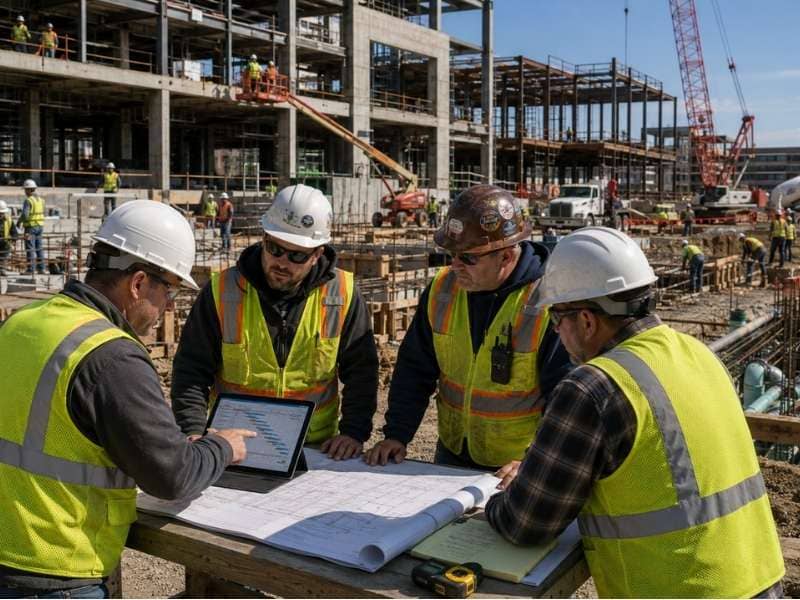
Construction management holds a project together when dozens of people, each with their own contract and their own priorities, have to work in the same place at the same time. Contractors, consultants, owners, agencies, and utility providers all depend on each other. Most of them never speak directly.
That gap is where projects go wrong. A missed answer, an unclear approval, a schedule nobody updated. On commercial and mixed-use work, small failures like these turn into delayed inspections, blown budgets, and work that has to come out and go back in.
Strong Construction Management Starts With Clear Decision-Making Roles
Ask a struggling project team who approves a change, and watch what happens. Three people point at each other. Nobody knows.
That confusion costs more than any single bad decision would. Work stops while the question travels through the org chart, and by the time an answer comes back, the crew has moved on to something else and lost a week.
Fix it at the start. Write down who decides what, who has to be consulted, and who simply needs to hear about it afterward. Set a dollar threshold above which the owner must weigh in, and let the team handle everything below it.
Set a clock on decisions, too. A change request that sits for three weeks with no answer has already caused damage, whether the answer eventually arrives or not. Teams that commit to a response window stay honest with each other.
Building a Schedule Around Dependencies Between Trades
A schedule that lists tasks in order tells you very little. A schedule that shows what each task waits on tells you where the project will actually break.
Trades stack on each other in ways that only become obvious when something slips. Concrete waits on rebar inspection. Framing waits on concrete. Rough-in waits on framing, and drywall waits on the inspector who signs off on rough-in. One late inspection ripples through four trades and lands on the finish crews at the end.
The most useful thing a construction manager does with a schedule is name those chains out loud. Which activities have no float. Which ones can slide two weeks with no harm. Which single approval, if it lands late, stops everything behind it.
Long-lead items belong in that conversation as well. Switchgear, elevators, and custom glazing can carry lead times measured in months, and no amount of field hustle recovers a piece of equipment that nobody ordered.
Tracking Design Questions Before They Affect Field Work
Every project generates questions. A detail doesn’t work. Two drawings disagree. A dimension leads nowhere.
The questions themselves are fine. The delay in answering them is the problem, and that delay usually comes from bad tracking rather than bad design.
A working system covers a few basics:
- One log where every question lives, visible to everyone
- A named person responsible for each answer
- A due date tied to when the field actually needs it
- A clear flag when an answer will change cost or schedule
- A record of the answer, attached to the drawing it changes
Field crews should never guess. A carpenter who builds something wrong because nobody answered a question in time has cost the project twice, once to build it and once to tear it out.
Answer speed matters more than answer elegance. A quick response that resolves the field question beats a perfect one that arrives after the crew already improvised.
Managing Changes Without Losing Control of Cost and Time
Changes happen on every job. Owners change their minds, conditions surprise everyone, and codes get interpreted differently than anyone expected.
Trouble starts when changes get handled informally. Someone tells a foreman to do it a different way, the crew complies, and nobody writes anything down. Three months later, a bill appears for work that never went through a contract, and the argument begins.
Run every change through the same path. Price it, evaluate its schedule impact, get the owner’s written approval, and only then let it into the field. The paperwork feels slow in the moment. It is far faster than the dispute it prevents.
The schedule impact deserves as much attention as the cost. Owners often approve a change based on the number alone, without realizing that a two-week delay to a critical activity pushes the completion date by two weeks. Present both figures together every time.
Construction Management Through Inspections and Project Closeout
Closeout is where good projects go to die. The building looks finished, everyone assumes the hard part is over, and momentum evaporates.
Inspections drive that phase, and they rarely arrive on demand. Agencies book out. A crew that reaches a milestone on Friday may wait ten days for the inspector, and every trade behind them waits too. Schedule inspections well ahead of when you need them, and treat those dates as fixed.
Closeout documents deserve the same discipline. As-built drawings, warranties, operation manuals, and lien releases pile up quickly, and chasing them from a contractor who has already moved to another job is miserable work. Collect them as the work completes rather than at the end.
The punch list is the last trap. It grows if you let it, so walk the building early, list what needs fixing, and hold the trades to a date. Owners remember how a project ended far more clearly than how it started.
Frequently Asked Questions
What separates construction management from general contracting?
A general contractor holds the trade contracts and carries the risk of building the work. A construction manager coordinates the process on the owner’s behalf, managing schedule, cost, communication, and quality. Some delivery methods blend the two, and the contract language decides who actually holds which responsibility.
When should construction management begin?
Preconstruction, well before anyone breaks ground. Decisions made during design shape the budget, the schedule, and how easily the project can be built. A manager who arrives after the drawings are complete inherits problems they could have prevented for free.
How do complex projects stay on schedule when delays happen?
They rarely avoid delays entirely. What they do is find them early, understand which ones threaten the completion date, and reorder work around the ones that don’t. A delay to an activity with float costs nothing. The same delay on the critical path costs the project a day for every day it lasts.
